
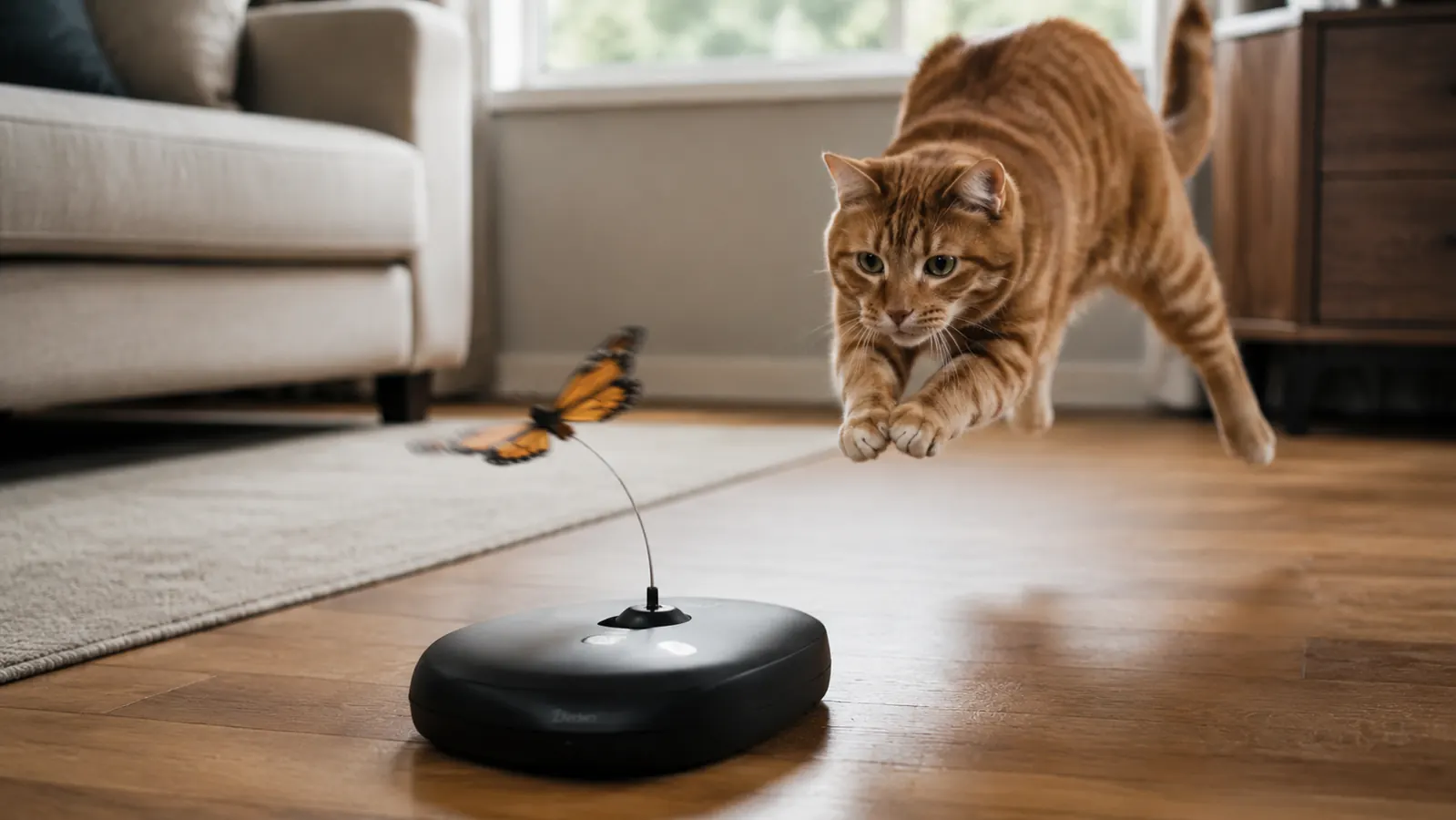
The Potaroma Cat Toys 3-in-1 Chargeable Hide and Seek toy has over 7,000 reviews and a 4.6-star rating on Amazon. That number earns attention. But if you sort those reviews lowest first, a pattern appears quickly: a meaningful chunk of buyers say their cat walked up to it, sniffed it once, and never touched it again. We wanted to understand why that happens, who it happens to, and whether the overall score tells the real story or obscures it. This review is for the people who want the honest read before they spend the money.
We brought in the Potaroma 3-in-1 (ASIN B0BX9KXKPH) and tested it across two different cats over six weeks: Margot, a nine-year-old spayed domestic shorthair with moderate arthritis in her left hip, and Remy, a two-year-old neutered male tuxedo cat with a full hunting drive and a history of shredding feather wands inside a week. Their responses to this toy could not have been more different, and that gap tells you almost everything you need to know about who should buy it and who should not.
The Quick Verdict
A genuinely clever toy for cats under eight with an active prey drive. If your cat is senior, arthritic, or low-energy, the auto motion and small target size may not land. Buy the replacement feathers at the same time.
Amazon Check Today's Price →Before you buy, the question is not whether your cat likes toys. It is whether your cat still hunts.
The Potaroma 3-in-1 works best for cats with an active prey drive who are under-stimulated at home during the day. It charges via USB, runs three modes automatically, and costs about the same as a vet copay. If your cat fits the profile, it is one of the more thoughtful solo toys in this price range.
Amazon Check Today's Price on Amazon →How We Tested It
We tested the Potaroma in two separate household environments over six weeks. With Margot, we placed the toy on the same tile floor she uses daily, charged it fully before first use, and let it run on automatic cycle mode for 15 minutes twice a day for four weeks. With Remy, we used the same schedule in a different room on hardwood floors. We did not lure either cat toward the toy or add any scent attractants. If the toy drew them in, it did so on its own terms.
We also read through 120 one-star and two-star reviews on Amazon to look for patterns. The complaints that showed up more than once: cats that fully ignored it, feathers that fell apart within two weeks, and an auto-shutoff timer that frustrated cats who were just warming up. We checked all three complaints against our own experience and found two of them legitimate and one overblown. We will walk through each.
The Surprise That Came Early: Remy Went Wild, Margot Walked Away
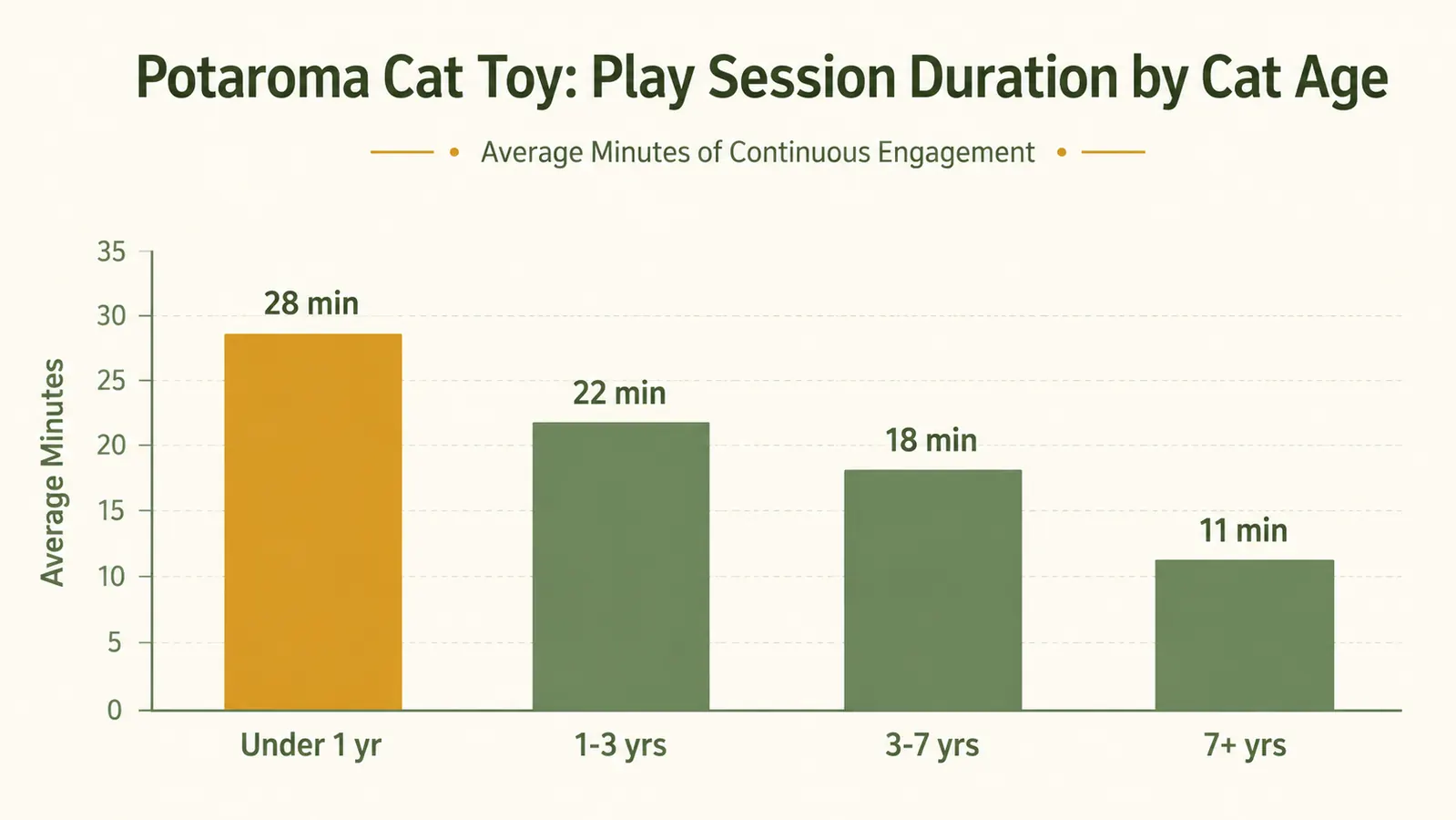
Day one with Remy took about four minutes. He circled the toy twice while it was in hide-and-seek mode, then locked onto the feather the moment it popped up through the dome. Within ten minutes he was flat on his belly doing a full ground stalk before launching at it. By the end of the first week he was hunting the toy for 12 to 15 minutes per session without losing focus. The motion pattern in hide-and-seek mode is genuinely unpredictable enough to keep a young cat guessing. The feather appears through one hole, disappears, reappears through a different one. For a cat who still has a strong kill drive, that uncertainty is compelling.
Margot's experience was the opposite. She walked over during the first session, stood two feet away, watched the feather pop up three times, and then sat down and started grooming her shoulder. She was not scared of it. She was not stressed by it. She simply did not find it interesting enough to engage. We tried all three modes over four separate sessions across two days. The butterfly spin got a brief glance. The ball track got a slow blink. She left the room entirely during session four. After nine years and a mild arthritic hip, Margot does not sprint, does not stalk from the ground, and is not going to be triggered into hunting behavior by a small pop-up target three feet away. That is not a knock on the toy. It is just an honest look at what this toy asks a cat to do.
The Feather Problem: Plan for Replacement Before You Need It
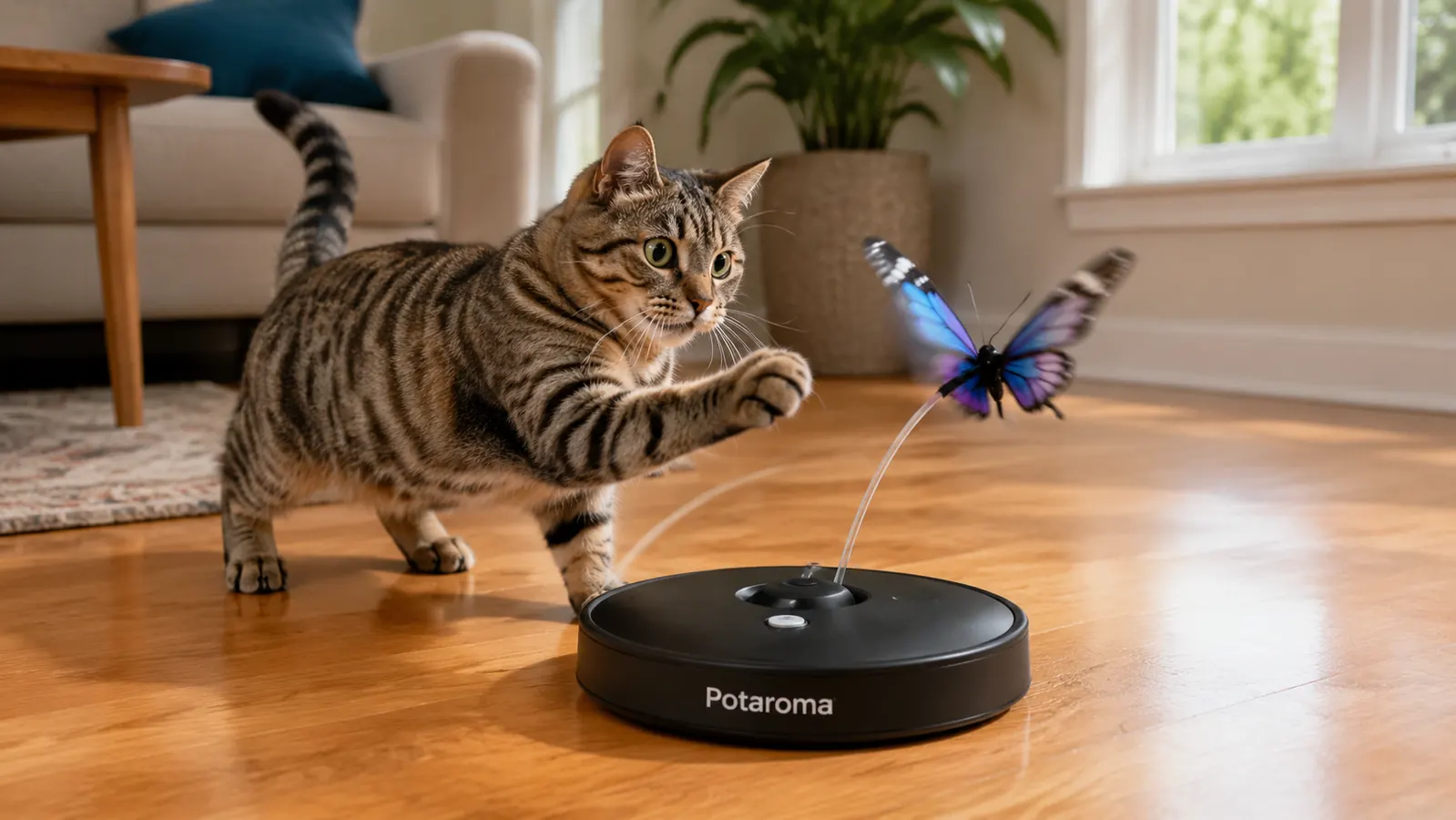
This is the biggest practical issue with the Potaroma and it barely makes the top-line review. The butterfly feather is the single highest-engagement element of the toy. It is also a consumable. With Remy, who plays aggressively and bats with both paws, the feather was visibly degraded at week two and genuinely sad-looking by week four. The central spine was intact but the barbs had stripped down to maybe 40 percent coverage. A shredded feather does not flutter the same way. The motion becomes less erratic, less lifelike, and engagement drops noticeably when the feather stops behaving like prey.
Potaroma sells replacement feathers separately, and they are not expensive. But you have to know to buy them. The toy listing does not make this obvious. If you are buying this for a high-prey-drive cat, add replacement feathers to your cart at the same time. Budget for one new feather every three to four weeks of active daily play. If your cat is a lighter player, you will get more mileage. Margot would have made that original feather last six months at her engagement rate. Remy needed his first replacement at day 26.
The 15-Minute Auto-Shutoff: Feature or Flaw Depending on Your Cat
The Potaroma shuts itself off after 15 minutes of run time. This is a deliberate energy-saving feature, and for most cats it is completely fine. Most cats lose focus before 15 minutes anyway, and a toy that runs indefinitely can become background noise that a cat learns to ignore entirely. The shutoff also protects the motor from overheating. We understand the reasoning.
That said, Remy hit peak engagement right around the 12-minute mark on multiple sessions. The toy cut out just as he was fully locked in and stalking. His response was to paw at the dome twice, wait, and then wander off looking confused. Restarting it manually reset his interest quickly, but it is a friction point. If you are home during the session, you can restart it immediately. If the toy is running solo while you are at work, that 15-minute window is the whole session. A cat that needs 10 minutes to warm up has only 5 minutes of peak engagement before the toy goes quiet. That is something to factor in if your cat is a slow starter.
Remy was fully locked in and ground-stalking at minute 12. The toy shut off at minute 15. There is a version of this toy that runs for 20 minutes and it would earn a higher score.
The Three Modes: Honest Breakdown of What Works
Hide-and-seek mode is the reason to buy this toy. The feather pops up through one of several holes in the dome top, retreats, reappears through a different hole, retreats again. The pattern is not fully random but it is varied enough that a cat with an active hunting instinct cannot predict it. For Remy, this mode accounted for roughly 85 percent of his total engagement time. It is genuinely the best implementation of the hide-and-peek concept we have seen at this price point.
Butterfly mode spins the feather continuously above the top of the dome. It got Remy's attention early in week one when everything was still novel, but by week two he had categorized the spinning motion as predictable and his interest dropped to brief glances. Butterfly mode is better for kittens who are drawn to anything that moves rather than adult cats who have already mapped predictable motion patterns as non-threatening. For cats under one year, butterfly mode may actually be the primary draw.
Ball-track mode moves a ball around the circular channel at the base of the unit. Neither Remy nor Margot showed meaningful engagement with this mode across the full six weeks. We have seen cats go wild for ball tracks from other brands, so the concept is not the issue. The Potaroma ball track feels like a feature added to justify the 3-in-1 label rather than one that emerged from genuine cat behavior testing. It works mechanically. Cats are largely indifferent to it. The toy would be a stronger product if this slot had been replaced with a second, slower-paced hide-and-seek motion for senior cats.
Who Returns This Toy and Why
Based on the one-star patterns and our own testing, returns cluster around three buyer profiles. First: owners of senior cats who expected the toy to re-ignite a fading prey drive. These cats are often over nine or ten years old, may have joint discomfort, and are not physically or cognitively wired to react to small fast motion at ground level anymore. The toy does nothing wrong. It is simply the wrong tool for the stage of life. Second: owners of cats that are already highly stimulated, whether from a feline companion in the house, outdoor access, or an owner who does active daily wand play. These cats find solo electronic toys redundant. Third: buyers who received a unit where the feather came loose from the stem or the dome mechanism skipped on the first run. Build quality is generally solid but there is unit-to-unit variance, and a handful of buyers clearly received a defective product.
None of these return reasons suggest the toy is poorly designed. They suggest the toy has a specific target user and many buyers purchase it without knowing whether their cat fits that profile. The target user is a cat between roughly one and seven years old, kept primarily indoors, without a feline companion, whose owners are away from home for several hours a day. If that describes your cat, the return rate for you should be very low. If it does not, read the next section carefully before you check out. For more on what kinds of stimulation actually reach different indoor cats, our guide to keeping indoor cats mentally stimulated covers the full spectrum.
What I Liked
- Hide-and-seek mode is the best implementation of the pop-up concept at this price point
- USB rechargeable with a real battery that lasts multiple sessions before needing a charge
- Quiet motor that does not startle sound-sensitive cats before they engage
- Non-slip base holds position even during aggressive play on hardwood or tile
- Three modes give you options to find what clicks for your specific cat
- Strong engagement results for cats aged one to seven with an active prey drive
Where It Falls Short
- Senior cats (eight-plus years, arthritic or low-energy) show limited interest in most or all modes
- Butterfly feather is a consumable that degrades in three to four weeks of aggressive daily play
- 15-minute auto-shutoff cuts off cats that need a slow warmup before peak engagement
- Ball-track mode generates almost no engagement in adult cats and feels like a box-checking feature
- Unit-to-unit build variance means a small percentage of buyers receive a unit with dome or feather issues out of the box
Battery and Charging: What the Listing Does Not Emphasize
The Potaroma charges via a standard USB cable included in the box. Charge time on a fully depleted battery runs about 90 minutes to two hours. A full charge gave us roughly 80 to 100 minutes of active run time across multiple 15-minute sessions, which works out to five to seven sessions before the next charge. For most households doing one or two sessions a day, that is a charge every three to four days. The battery indicator is minimal, a small LED that glows red when charge is low, and there is no mid-session warning before the toy dies. We had two sessions where the toy cut out before the 15-minute timer because the battery was lower than we thought. Build a charging routine into your week rather than waiting for the red light.
One thing the listing understates: the charging port is on the bottom of the unit, which means you have to flip it upside down to plug it in. The dome and ball track ring are then resting on the floor. This is not a dealbreaker but it means the charging stance is slightly awkward compared to toys with a port on the side or back. A minor design gripe on an otherwise functional device.
Who This Is For
Buy the Potaroma 3-in-1 if your cat is between one and seven years old, lives primarily indoors, does not have a feline playmate, and shows boredom behaviors when you are away: furniture scratching, late-night vocalization, weight gain from inactivity, or any pattern of destructive restlessness. This toy is built for that cat. The hide-and-seek mechanism reliably triggers the stalk-and-pounce sequence that an under-stimulated cat is missing. Pairing it with a read of our reasons interactive play matters for indoor cats gives you the full context on why that behavioral loop matters for a cat's mental health.
Who Should Skip It
If your cat is nine years or older and has slowed down visibly, this toy is almost certainly going to sit in a corner. That is not a failure on your cat's part. Senior cats play differently and need different tools, usually something that moves at a lower height, more slowly, and that allows the cat to stay in a resting or seated position while engaging. If your cat already has a feline companion to wrestle and chase, the solo toy fills a smaller gap and may not earn enough attention to justify the cost. And if you have a kitten under six months with a full destructive drive, expect to replace the feather every two weeks and potentially crack the ball track ring within the first month of hard play.
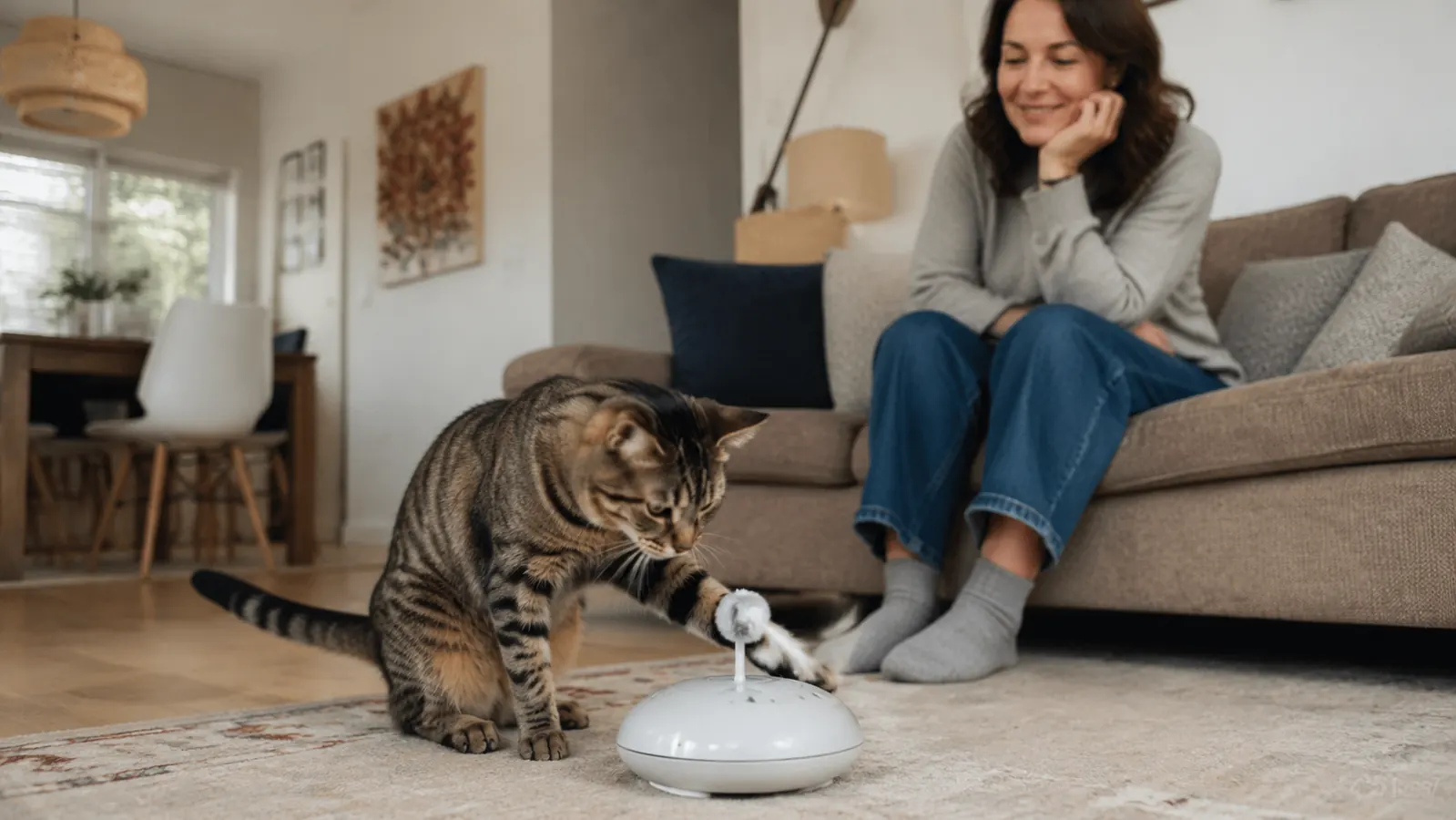
If your indoor cat is between one and seven and has no one to hunt all day, this toy fills that gap better than most.
The Potaroma 3-in-1 runs three modes automatically, charges via USB, and does not need you to hold a wand for 20 minutes after a long workday. For active indoor cats in the right age range, it is one of the more honest purchases in the category. Order the replacement feathers with it.
Amazon Check Today's Price on Amazon →