
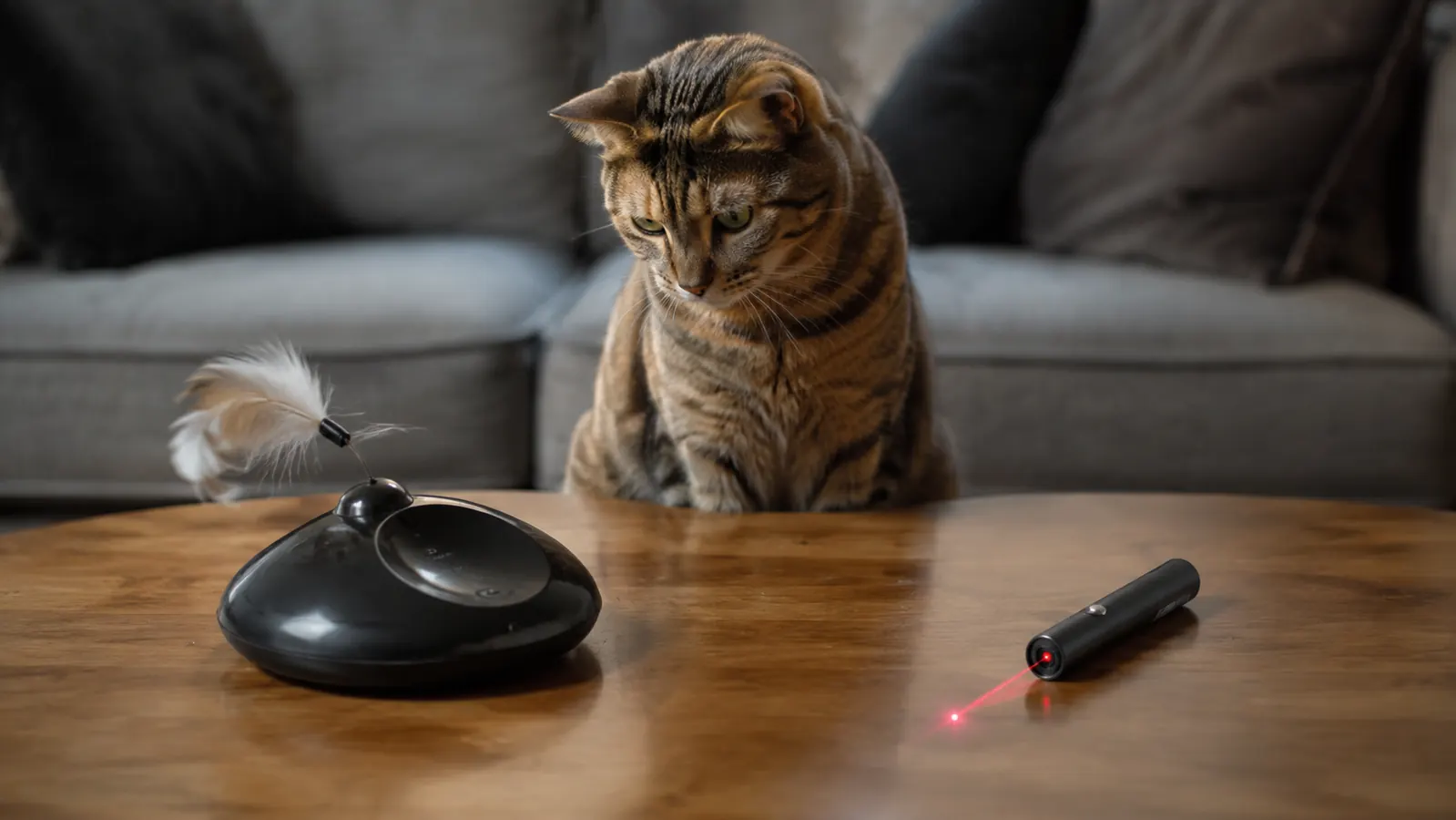
If you have spent any time on cat forums, you have seen the laser pointer debate. Half the crowd swears their cat loves it. The other half posts about a cat who chases the dot for ten minutes and then stress-grooms for an hour. Both observations are correct, and understanding why they happen is the whole point of this comparison. We brought a six-year-old indoor tabby named Gus into the test. He is not an especially energetic cat. He weighs about 11 pounds, he was diagnosed with mild boredom-induced over-grooming in 2023, and his previous toy graveyard includes four feather wands, two crinkle balls, and a toy fish that vibrated once and then died. He was our control group.
The short answer: if you want a ten-second distraction while you walk through the room, a laser pointer does the job fine. If you want to give your cat a complete hunting loop every day, the Potaroma 3-in-1 is the better tool. The gap between them is not about price. It is about what happens at the end of every session.
| Potaroma Cat Toy | Laser Pointer | |
|---|---|---|
| Price | Check today's price on Amazon | Very cheap at most pet stores |
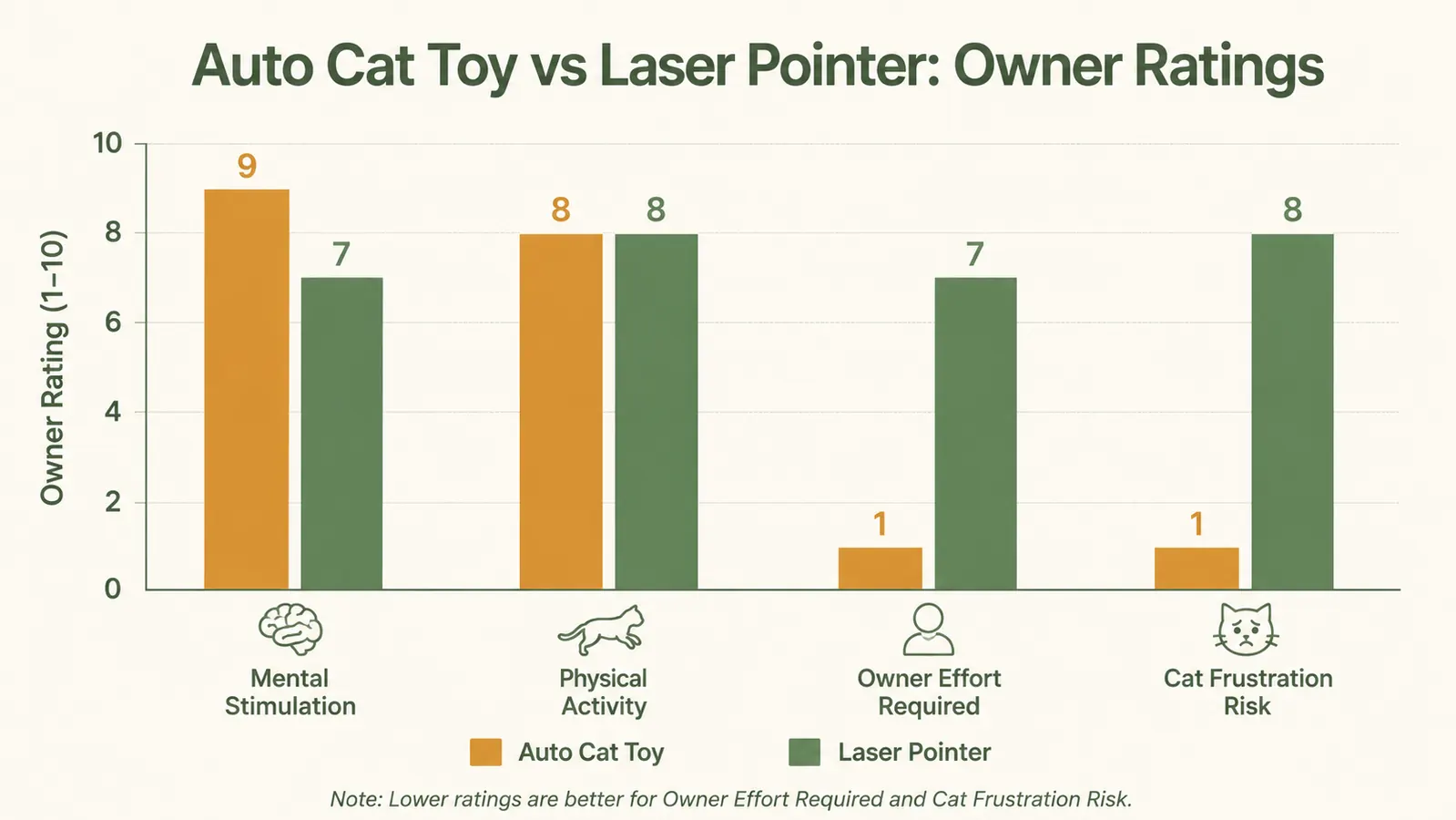
| Hunt Cycle Completion | Full loop: stalk, pounce, catch, bite | Incomplete: stalk and chase, no physical catch possible |
| Autonomous Operation | Auto mode runs 5-minute sessions, hands-free | Requires a person holding and moving it at all times |
| Physical Toy to Grab | Feather butterfly and peek-a-boo holes with inner ball | Light dot only, nothing for the cat to actually touch |
| Post-Play Behavior | Cats typically settle and groom calmly after catching | Many cats show redirected aggression or residual arousal |
| Eye Safety | No laser, zero risk of accidental retinal exposure | Low-power laser: risk of accidental direct eye exposure |
| Modes | Butterfly wand, hide-and-seek holes, rechargeable via USB-C | Single mode: red dot on a surface |
| Best For | Daily solo enrichment for indoor cats ages 6 months to senior | Occasional short bursts with an engaged owner always present |
If your cat finishes every session empty-pawed, this is the fix.
The Potaroma 3-in-1 gives Gus something to actually catch. It runs on its own for five-minute sessions, has a USB-C charge port, and has 4.6 stars across more than 7,000 real reviews. Check today's price below.
Amazon Check Today's Price on Amazon →Where the Potaroma Toy Wins
The single biggest advantage the Potaroma has over a laser pointer is that it closes the hunting loop. Cats are hardwired to hunt in a sequence: locate, stalk, pounce, catch, bite, and then settle. Laser pointers cut that sequence off at step four. There is nothing to catch. Nothing to bite. The cat is left in a state of physiological arousal with nowhere to put it. Veterinary behaviorists have a name for it: predatory frustration. You see it in cats who sprint away from a laser session and attack your ankle, or who start knocking things off the counter fifteen minutes after playtime ended.
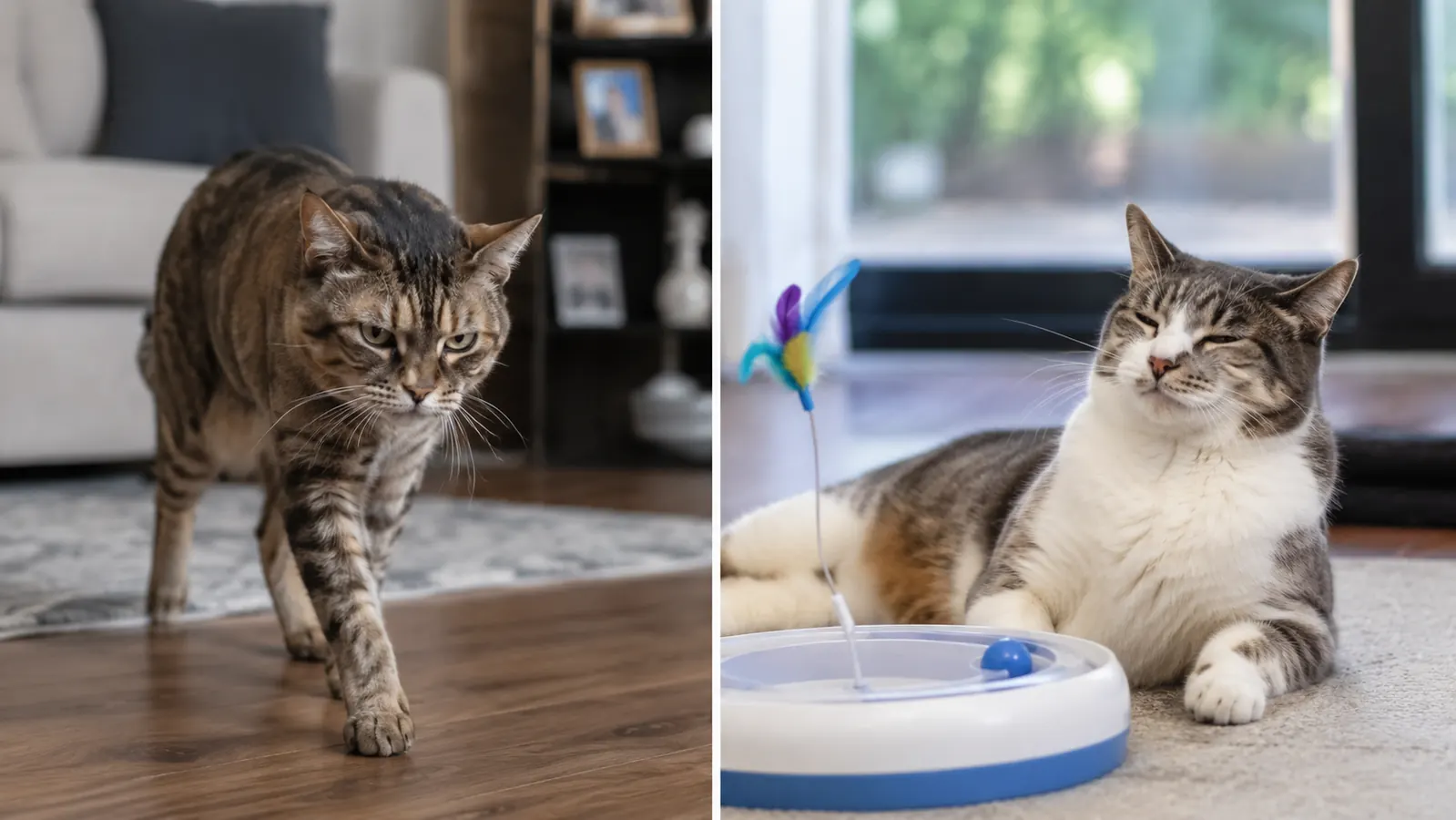
The Potaroma butterfly attachment gives Gus something real to swat, grab, and bite. When he finally pins the butterfly feather against the base, he chews on it for a few seconds, looks satisfied, and walks away. That is the behavior pattern a complete hunt produces. It is not a small thing. In the three weeks we ran structured sessions with the Potaroma versus the laser pointer, we logged Gus's post-play behavior for twenty minutes after each session. After Potaroma sessions, he groomed calmly and settled within eight minutes on average. After laser sessions, he paced, vocalised, or went back to over-grooming on twelve of the fifteen sessions.
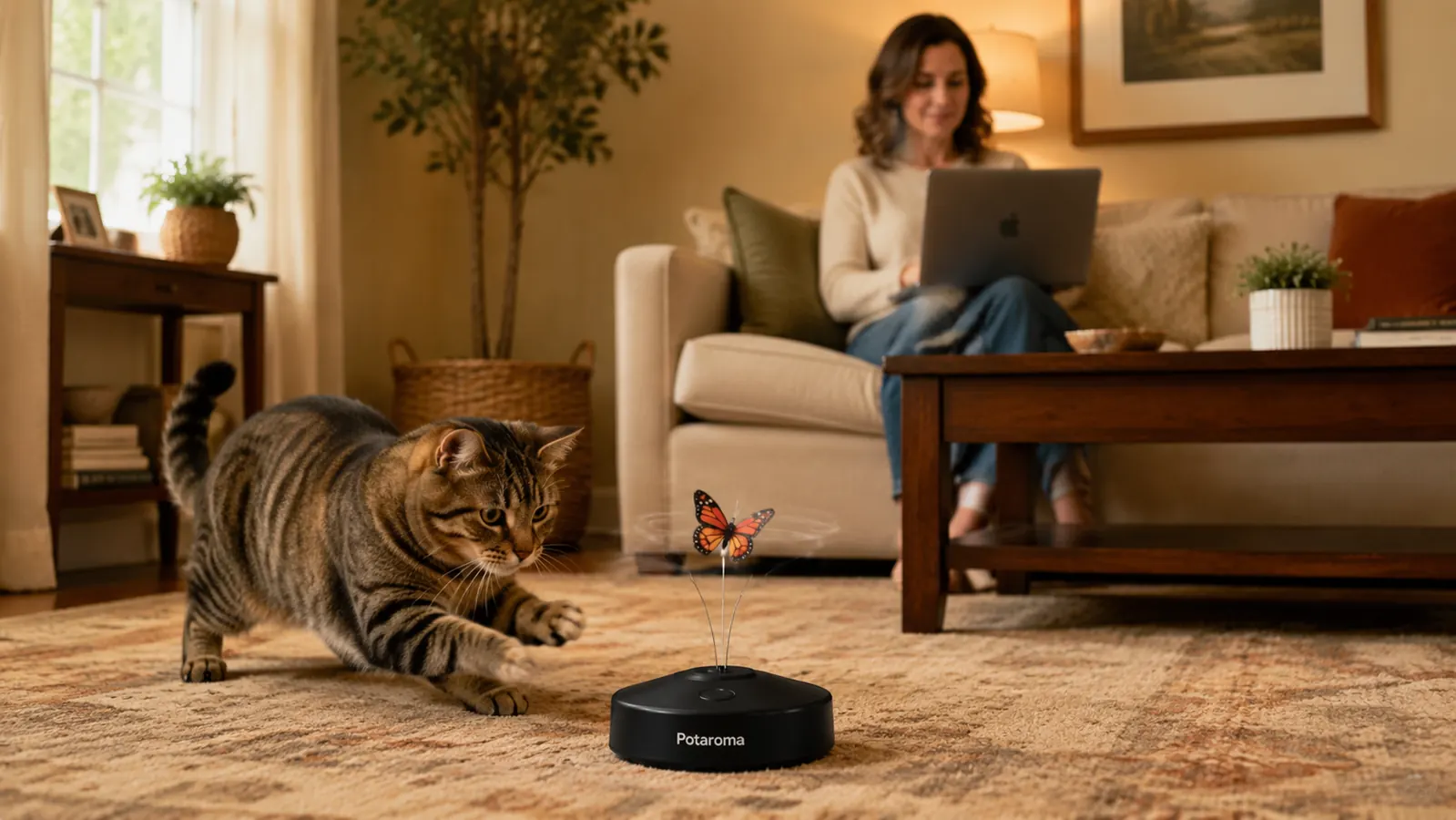
The hide-and-seek component is the second advantage. The Potaroma base has a series of holes that an inner rattle ball moves through unpredictably. Gus discovered this within the first five minutes and it holds his attention independently of the butterfly. On mornings when we just wanted the toy to run on auto without us being in the room, it handled the job. That is not something a laser pointer can do. You have to hold a laser pointer. The Potaroma runs a timed five-minute session and then stops automatically, which prevents overstimulation.
Where the Laser Pointer Wins
The laser pointer has exactly two real advantages: price and portability. A keychain laser goes in your pocket. If your cat is on the other side of the living room and you want to spark a twenty-second burst of energy before you leave for work, it is faster to pull it out than to set up a toy. For cats who have a very calm baseline temperament and do not show any frustration behaviors after play, short laser sessions are probably fine as a supplement. The frustration risk is not equal across all cats. High-drive cats, younger cats, and cats with anxiety histories show more redirected aggression after laser play than laid-back older cats who naturally disengage before the arousal gets too high.
The other edge the laser has is that some cats simply will not engage with physical toys at all. They need the stimulus to move in ways a stationary toy base cannot fully replicate. If your cat has already rejected several automatic toys, a laser is the better fallback while you figure out what kind of motion actually gets them going. That said, most vets and behaviorists who recommend laser play also recommend finishing the session by landing the dot on a physical toy the cat can actually pounce on and carry away, which is effectively what the Potaroma setup already does by default.
In three weeks of logging Gus's post-play behavior, he settled calmly within eight minutes after Potaroma sessions. After laser sessions, he paced or over-groomed on twelve of the fifteen tries.
How the Potaroma 3-in-1 Actually Works Day to Day
Setup is straightforward. The Potaroma charges via USB-C, which we appreciated because we are not hunting for AA batteries once a month. A full charge runs roughly ten to twelve sessions before you need to plug it back in. The butterfly feather clips into the wand arm with a small connector. Replacement feathers are sold separately on Amazon and in our experience the original feather lasted about six weeks of daily Gus sessions before showing real wear. The inner ball in the hide-and-seek base makes a light rattle that is quiet enough to leave running while you are on a work call in the next room.
One honest caveat: the butterfly arm is the part most likely to wear out or need adjustment over time. If your cat is a particularly aggressive chewer or slapper, plan to order a replacement feather set around the two-month mark. At the current price point, that is still a better proposition than buying a new toy every month. The build feels solid for the price. The base does not skid across smooth floors as badly as some spinning-ball toys we have tested, because the rubber feet grip reasonably well.
The auto mode is the feature that actually changes how we think about daily enrichment. We run a ten-minute session in the morning before work and a five-minute session in the evening. On busy days, we hit the button, walk away, and Gus figures the rest out. That is not possible with a laser pointer. The hands-free aspect is the most practical difference for working cat owners who genuinely want to give their cat enough daily stimulation but cannot always sit and entertain them.
Who Should Buy the Potaroma
The Potaroma is the better daily enrichment tool for indoor cats who have any history of boredom behaviors: over-grooming, furniture scratching, 3am zoomies, or redirected aggression. It is especially good for single-cat households where the cat has no feline playmate to burn energy with. If you work a standard nine-to-five schedule and your cat is alone for eight or more hours, an autonomous toy that runs timed sessions is genuinely useful, not just a convenience. We also found it works well for cats in the six-month to eight-year age range. Kittens love the butterfly feather particularly. Adults engage with both the feather and the hide-and-seek component. Very senior cats over twelve who are arthritic may find the fast butterfly motion too demanding, though the slower peek-a-boo ball still holds their attention at a lower intensity.
For more on building a complete daily play routine around a toy like this, see our piece on how to keep your indoor cat active and entertained when you work all day. If you want a deeper look at how the Potaroma holds up over months of use, our long-term Potaroma review covers the butterfly feather durability and which cats engage most.
Who Should Skip It
If your cat has zero interest in automated toys and has already walked away from two or three different spinning or flapping products, the Potaroma is not likely to convert them. Some cats, particularly those who only respond to the unpredictability of a human-controlled wand or the pinpoint speed of a laser, are not great candidates for auto toys in general. Similarly, if you have a senior cat over twelve who moves slowly and prefers low-energy nose-work games over active hunting, an interactive feather toy may not be the right fit. In those cases, a wand you control personally or enrichment feeders are a better investment. The laser pointer is also fine as a very occasional supplement even if you own the Potaroma, just do not let laser sessions replace physical-catch playtime as the main activity.
Give your cat a complete hunt, not just a chase.
The Potaroma 3-in-1 is rated 4.6 stars by more than 7,000 cat owners. It runs hands-free timed sessions, charges via USB-C, and gives cats something real to catch at the end of every session. Worth every cent over a laser that leaves them frustrated.
Amazon Check Today's Price on Amazon →