
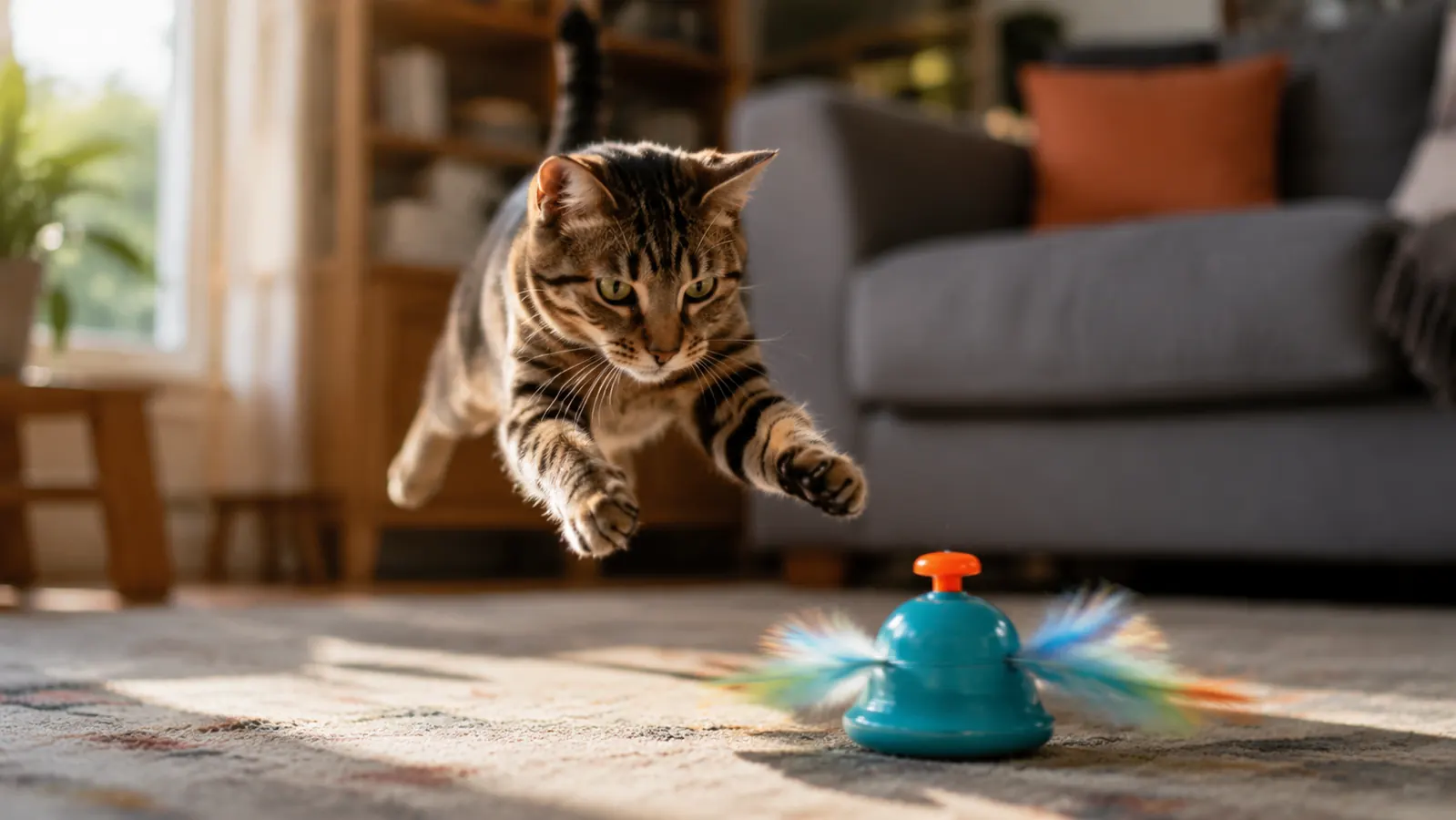
A cat who lives entirely indoors is still, neurologically, a predator. She has the same hunt-kill-eat-groom-sleep cycle hardwired into her brain that her outdoor cousins run through multiple times a day. When nothing in the apartment moves fast enough to chase, that cycle stalls at 'hunt' with nowhere to go. That bottled-up drive is where most of the behavior problems we hear about start: midnight zoomies, aggressive pouncing on ankles, compulsive grooming, destroying furniture, or just a flat listlessness that reads as 'being a cat' but is actually closer to chronic under-stimulation.
We built this list because we get asked constantly what the single best thing an indoor cat owner can do for their cat's wellbeing. The answer is not a fancier bed or a subscription food box. It is fifteen to twenty minutes of intentional interactive play every day. The Potaroma 3-in-1 interactive cat toy (ASIN B0BX9KXKPH, rated 4.6 stars across more than 7,100 Amazon reviews) has become our go-to recommendation because it covers three play modes in one rechargeable unit: hide-and-seek peek-a-boo, an automatic spinning butterfly feather, and a teaser wand mode. But the 'why play' matters just as much as the 'what to use,' so here are the ten reasons we give to every cat parent who asks.
Your cat's boredom has a fix that costs less than a vet visit.
The Potaroma 3-in-1 covers hide-and-seek, butterfly, and wand play in one rechargeable toy. Over 7,100 cat owners rate it 4.6 stars. Check today's price before it moves.
Amazon Check Today's Price on Amazon →It Burns the Physical Energy That Has Nowhere Else to Go
Indoor cats do not roam territories the way outdoor cats do, but their bodies still produce the same caloric surplus designed for that movement. Without an outlet, that surplus turns into weight gain. A focused play session with something that actually moves, like the Potaroma butterfly mode which spins unpredictably so the cat cannot pattern it, burns real energy in a short window. We have seen cats lose noticeable condition improvements within two months of adding daily sessions.
It Satisfies the Hunt Drive Before It Finds Your Ankles
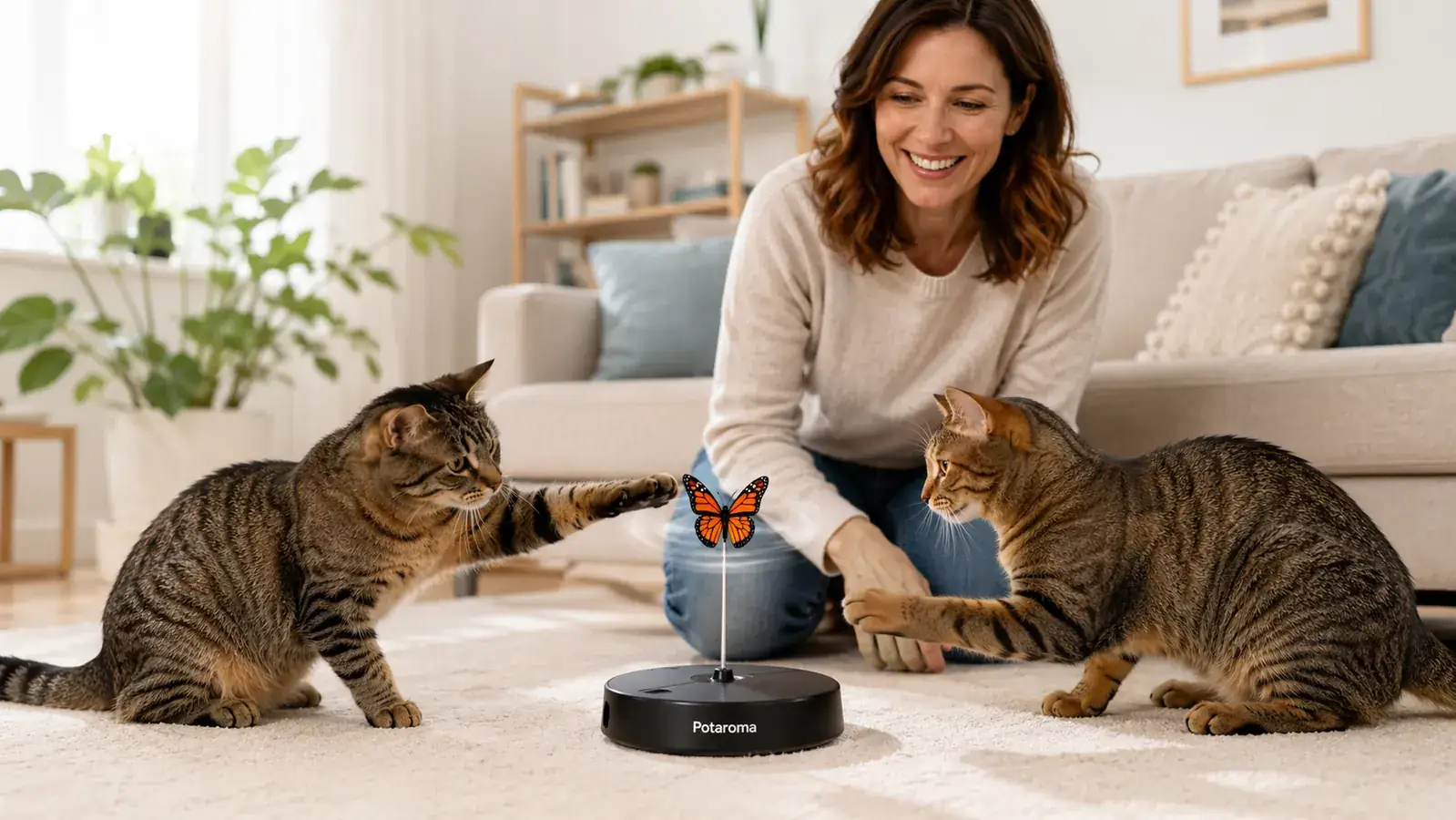
Ankle ambushes and couch launches are not personality quirks. They are cats rerouting an unsatisfied hunt drive toward the only things in the apartment that move: you. Redirecting that drive into a toy that fights back, retreats, and hides is almost always enough to stop it. The Potaroma's peek-a-boo mode slides a cover over the moving base so the toy 'disappears,' which triggers the stalking phase and gives it a proper start-to-finish hunt sequence.
It Reduces Stress-Linked Over-Grooming
Cats who over-groom to the point of bald patches or skin irritation are often flagged as 'anxious' and put on medication when the underlying issue is chronic under-stimulation. Physical play lowers cortisol, gives the cat something to focus on beyond her own fur, and tires her out enough that the compulsive loop breaks. This does not replace a vet conversation if the behavior is severe, but play is always step one.
It Keeps the Brain Sharp as Cats Age
Cognitive decline in senior cats is real and moves faster in under-stimulated animals. A toy that changes behavior, like the Potaroma's randomized butterfly spin speed, forces the cat to recalculate her pounce approach every time. That small demand on working memory, repeated daily, is meaningful enrichment. We specifically recommend the automatic mode for senior cats because it removes the human timing variable and runs on a predictable fifteen-minute session cycle that does not over-tire them.

It Prevents the Flat Affect That Looks Like 'Chill' But Is Not
Cats who sleep eighteen to twenty hours a day and show little interest in anything are sometimes described as 'low-key' or 'easy.' In our experience, a surprising number of them are bored into a kind of learned helplessness. When we introduce a genuinely compelling toy into that environment, the change in body language within a week is noticeable: brighter eyes, more vocalizing, more interest in windows and movement. The cat was never 'chill.' She was stuck.
It Supports Healthy Weight Without Diet Restriction
Cutting a cat's food is a stressful intervention for both cat and owner. Adding daily play achieves the same caloric balance from the other side of the equation, and most cats accept it far more graciously. For a cat who is five to ten percent above target weight, two fifteen-minute sessions a day with an active toy can produce the same slow, healthy downward trend that a mild food reduction would, without the hunger-driven food aggression some cats develop on restricted diets.
It Strengthens the Bond Between Cat and Owner
Even when a toy like the Potaroma runs automatically, the ritual of setting it up, watching together, and doing a wand session after builds a shared routine the cat comes to expect from you. Cats bond through predictable, positive, activity-linked interactions. A cat who associates you with play sessions is a cat who seeks you out for proximity, not just food.
It Reduces Night-Time Disruption
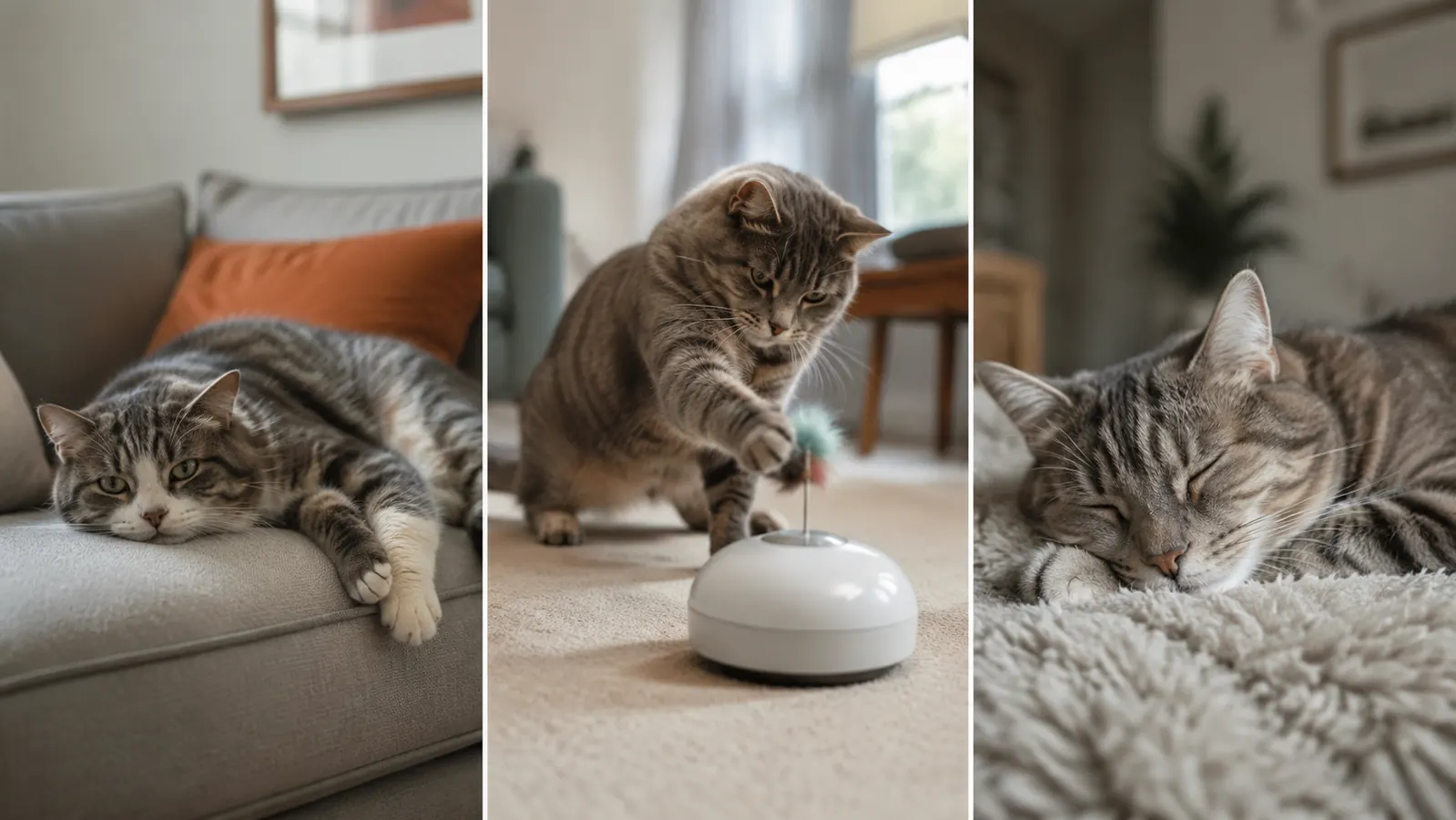
Cats are crepuscular by nature, meaning they are wired for activity at dawn and dusk. When that energy is not spent during the day, it often surfaces at 2am as sprinting, yowling, or jumping on your face. A solid play session in the early evening, followed by a meal, mimics the hunt-eat-sleep sequence and shifts their internal clock toward sleeping when you sleep. This is the single most consistent outcome we hear from cat owners who commit to a daily play routine.
It Is One of the Cheapest Vet-Prevention Tools Available
Obesity, urinary stress issues, feline idiopathic cystitis, and stress-related skin conditions each carry real vet bills. All of them have a documented link to under-stimulation and inactivity in indoor cats. The Potaroma toy costs less than two of those vet appointments. We are not saying play is medicine, but we are saying that the research on enrichment as a preventive health tool for indoor cats is well-established and largely ignored by owners who think toys are optional extras.
It Works Even When You Are Too Tired to Hold a Wand for Twenty Minutes
The most honest argument for a rechargeable automatic toy is consistency. You will not always have the energy to wave a feather wand after a long day. The Potaroma runs on its own, auto-shuts off after fifteen minutes so the cat does not burn out on it, and recharges via USB so there are no batteries to forget. Consistency matters more than session intensity. A reliable fifteen-minute automatic session every evening beats an enthusiastic weekend session flanked by nothing. For a deeper look at how the toy performs across different cat personalities, see our <a href="/potaroma-cat-toy-review-long-term">Potaroma 3-in-1 long-term review</a> and our <a href="/potaroma-cat-toy-honest-review">honest breakdown of which cats love it most</a>.
What We Would Skip
Laser pointers are the category we consistently steer people away from for daily play. They trigger the hunt drive intensely but offer no physical catch at the end, which leaves cats in a state of frustrated arousal rather than the satisfied tiredness you want after a session. Some cats develop obsessive light-chasing behaviors that generalize to reflections on walls and ceilings. If your cat is already engaged with a laser, pair every laser session with a physical toy at the end so she gets the catch. But as a standalone daily tool, we think a laser pointer creates more problems than it solves.
The most common thing we hear after a cat owner commits to daily interactive play for two weeks is some version of: 'I feel like I got a completely different cat.' The cat did not change. The cat finally got what she needed.
Fifteen minutes a day is all it takes. The Potaroma makes it automatic.
Three play modes, USB rechargeable, auto-off timer, and 4.6 stars from over 7,100 cat owners. Check current pricing on Amazon before your cat finds your couch first.
Amazon Check Today's Price on Amazon →