
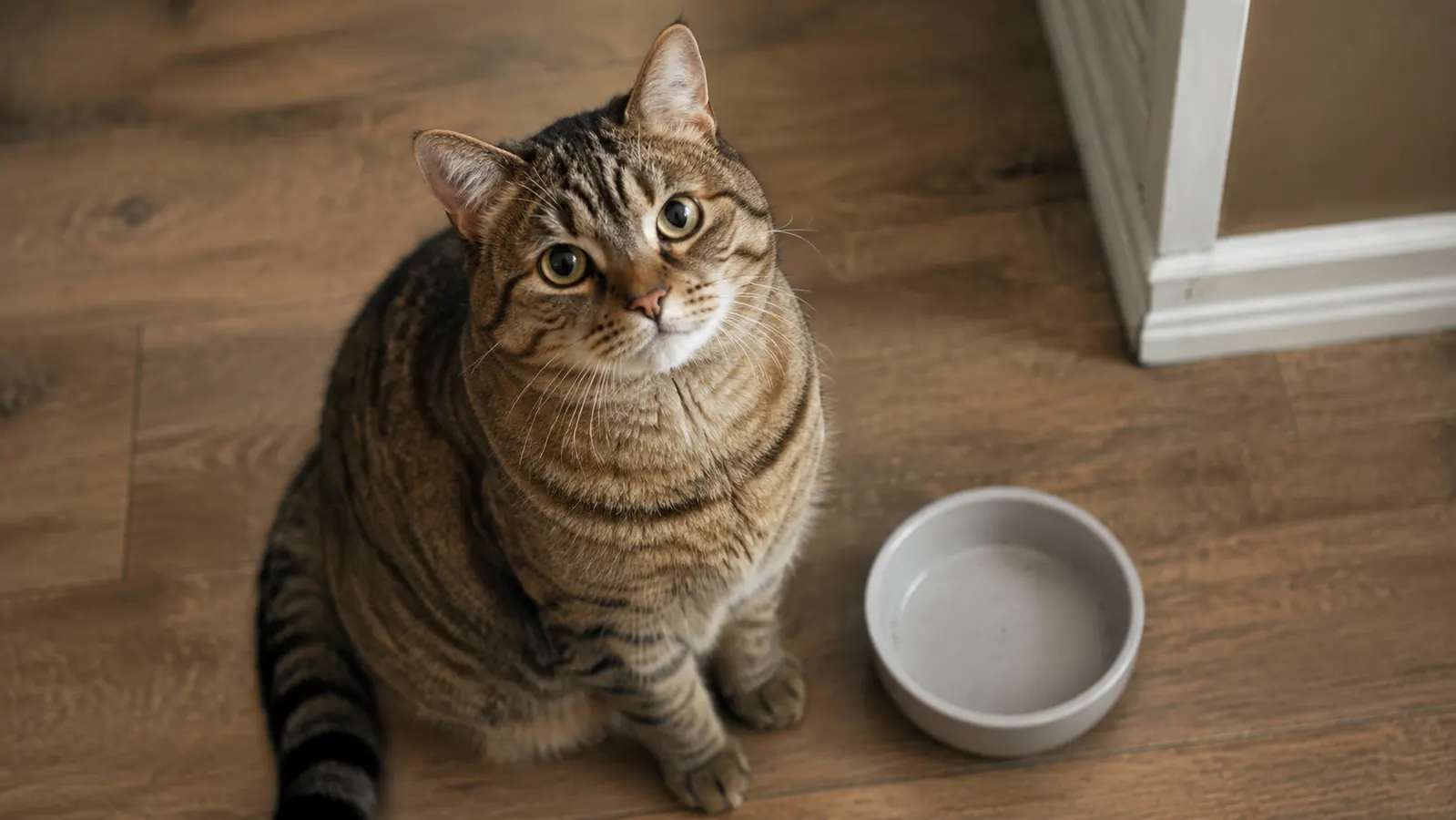
Overfeeding a cat is one of the easiest mistakes to make and one of the hardest to notice until it becomes a problem. It rarely starts with bad intentions. It starts with a hungry look, a persistent meow at 6am, or the genuine uncertainty of not knowing whether the last meal was enough. One extra handful of kibble a day, 365 days a year, can add a full pound of fat to a cat who only weighs ten pounds. At that weight ratio, that is the equivalent of a 180-pound adult gaining 18 pounds from small, forgettable snacks. Veterinary data consistently shows that roughly 60 percent of indoor cats in the United States are overweight or obese, and portion inconsistency is the most commonly cited cause. This five-step guide, built around the HoneyGuaridan 3.5L automatic cat feeder, is designed to fix that without guilt and without guesswork.
The good news is that solving overfeeding does not require willpower or constant vigilance. It requires a clear calorie target, a reliable way to measure portions, a consistent feeding schedule, and a tool that removes the human variable entirely. This guide walks through all five steps in order. By the end, you will know exactly how much your cat should eat, how to divide that across the day, and why the HoneyGuaridan 3.5L automatic cat feeder is the tool we trust to hold the line every single time.
The feeder that measures every meal so you don't have to.
The HoneyGuaridan 3.5L dispenses precise portions up to six times per day. Stainless steel bowl, programmable schedule, and a 4.3-star rating from more than 7,400 verified buyers. If portion control is the goal, this is where we start.
Amazon Check Today's Price on Amazon →Step 1: Find Out What Your Cat Actually Weighs Right Now
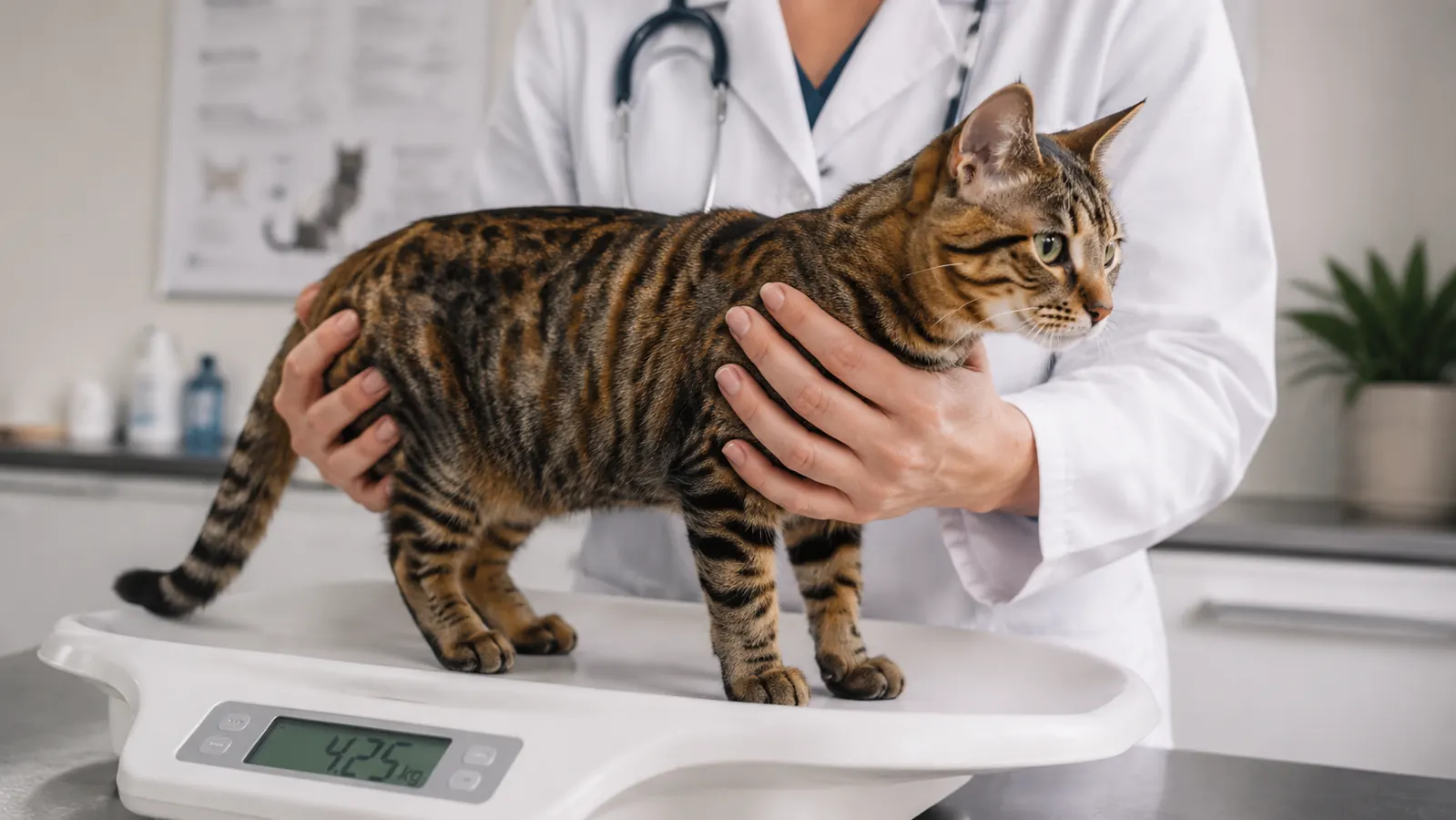
You cannot hit a calorie target if you do not know the starting number. The starting number is your cat's current body weight, not their ideal body weight. These two things are often different, and confusing them is how owners accidentally underfeed during a weight-loss plan or overfeed a cat who is already at a healthy weight.
Weigh your cat at home by stepping on your bathroom scale while holding them, then stepping on again without them, and subtracting. For a more accurate reading, a flat kitchen scale works well for cats under 12 pounds. Write the number down. If your vet has suggested a target weight, write that down too. If you are unsure whether your cat is overweight, run your hands firmly along their sides. You should be able to feel the ribs without pressing hard. If you cannot, your cat is carrying extra weight. If you can see the ribs without touching them, they may be underweight. Most indoor cats should fall between 8 and 11 pounds depending on breed and frame.
For large breeds like Maine Coons or Ragdolls, healthy weight runs considerably higher, sometimes into the 15 to 20 pound range for males. The rib check is more reliable than a number alone for these breeds. Your vet can give you a Body Condition Score on a 1-to-9 scale, which is the most standardized way to assess ideal weight for your specific cat.
Step 2: Calculate the Right Daily Calorie Target
The baseline formula most feline nutritionists use for an adult indoor cat is a Resting Energy Requirement, or RER, calculated as 70 multiplied by the cat's weight in kilograms raised to the power of 0.75. For practical purposes, a simpler approximation most owners can work with is 20 calories per pound of ideal body weight per day for a spayed or neutered indoor cat with low to moderate activity. A 10-pound neutered indoor cat with no health conditions needs roughly 200 calories per day.
If your cat is currently overweight and your vet has cleared a slow weight-loss plan, the typical approach is to feed 80 percent of the calories needed for their ideal target weight, not their current weight. So if your cat weighs 12 pounds but should weigh 10, you feed for the 10-pound target at 80 percent: roughly 160 calories per day. Weight loss in cats should always be gradual. Losing more than half a pound per month in a small cat risks a serious liver condition called hepatic lipidosis. If your vet has prescribed a specific calorie limit, use that number and ignore the general formulas.
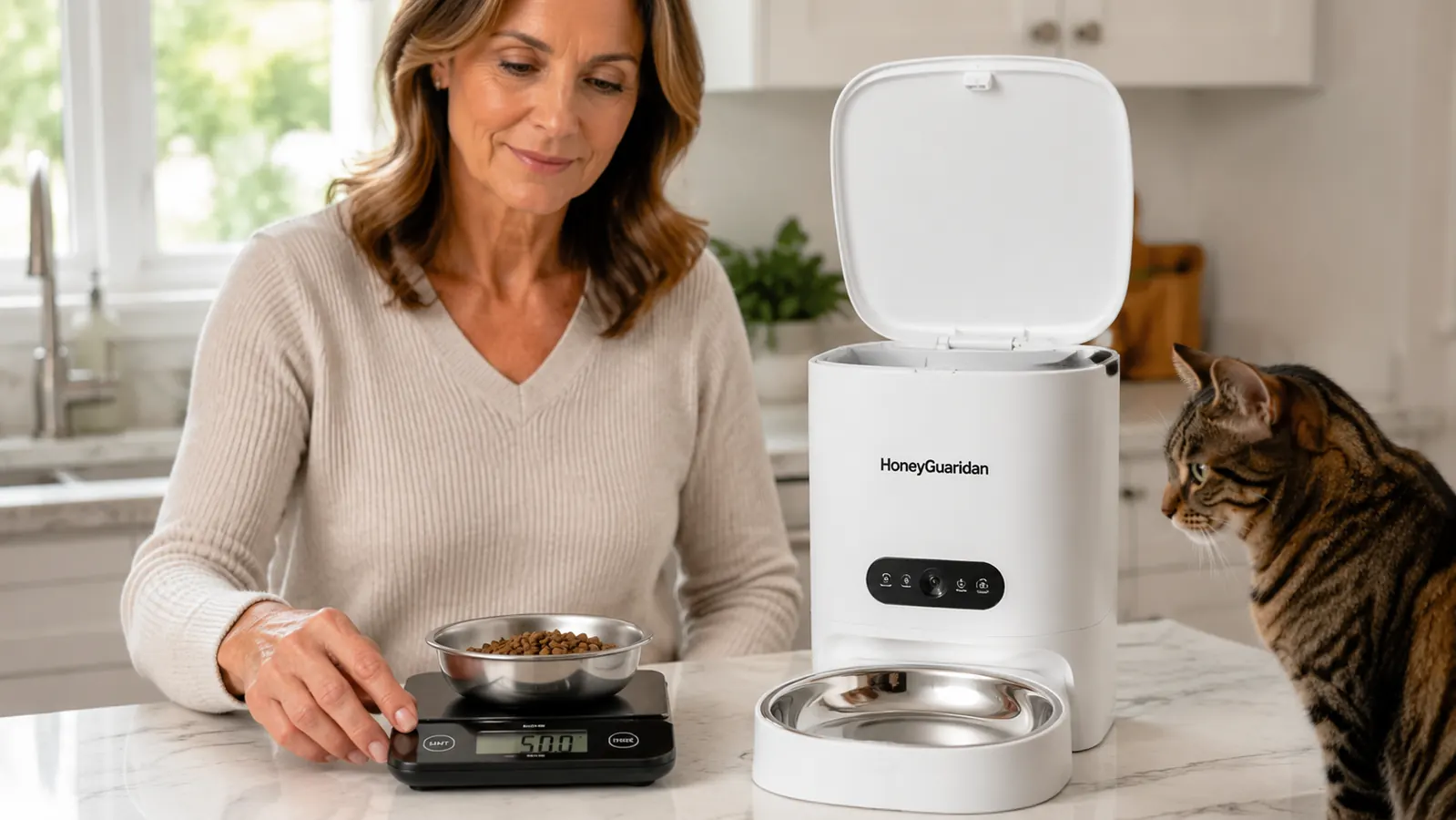
Once you have a daily calorie number, convert it to cups or grams of food using the calorie density printed on your cat's food bag. Most dry kibbles run between 300 and 500 calories per cup. A bag that lists 380 calories per cup means a 200-calorie cat gets just over half a cup per day. This is the number that most owners discover is smaller than what they have been serving. Weigh it out on a kitchen scale and you will see exactly how little it looks in the bowl.
Step 3: Divide Daily Food Into Multiple Smaller Meals
Cats in the wild eat multiple small meals per day, not one or two large ones. The typical feral or outdoor cat eats 8 to 16 small prey items over a 24-hour period. Indoor cats fed once or twice a day often scarf their food in under two minutes, spend the rest of the day food-focused and anxious, and beg aggressively before every meal. This behavior is frequently misread as hunger and rewarded with extra food.
Splitting the same daily total into four, five, or six smaller portions reduces food-obsessive behavior, improves digestion, and stabilizes blood sugar. The challenge with multiple small meals is the logistics. Most owners cannot be home five times a day at consistent intervals. This is exactly the problem an automatic feeder solves. The HoneyGuaridan programs up to six scheduled feedings per day, each at a specific time down to the minute. You set the total daily amount, divide it across however many meals you choose, and the feeder handles the rest whether you are home, at work, or traveling.
For a 200-calorie cat eating half a cup of kibble per day, dividing into four meals means about two tablespoons per portion. The HoneyGuaridan dispenses in 1/12-cup increments, which is fine enough to hit that target accurately. Each portion drops into the stainless steel bowl at the scheduled time with a recorded voice message you can customize, which helps signal to food-anxious cats that mealtime has arrived and reduces anticipatory yowling.
Splitting the same daily total into four or five meals reduces food-obsessive behavior, improves digestion, and removes the moment-to-moment pressure of deciding whether to give a little more.
Step 4: Set Up Your HoneyGuaridan Feeder for Precision Portions
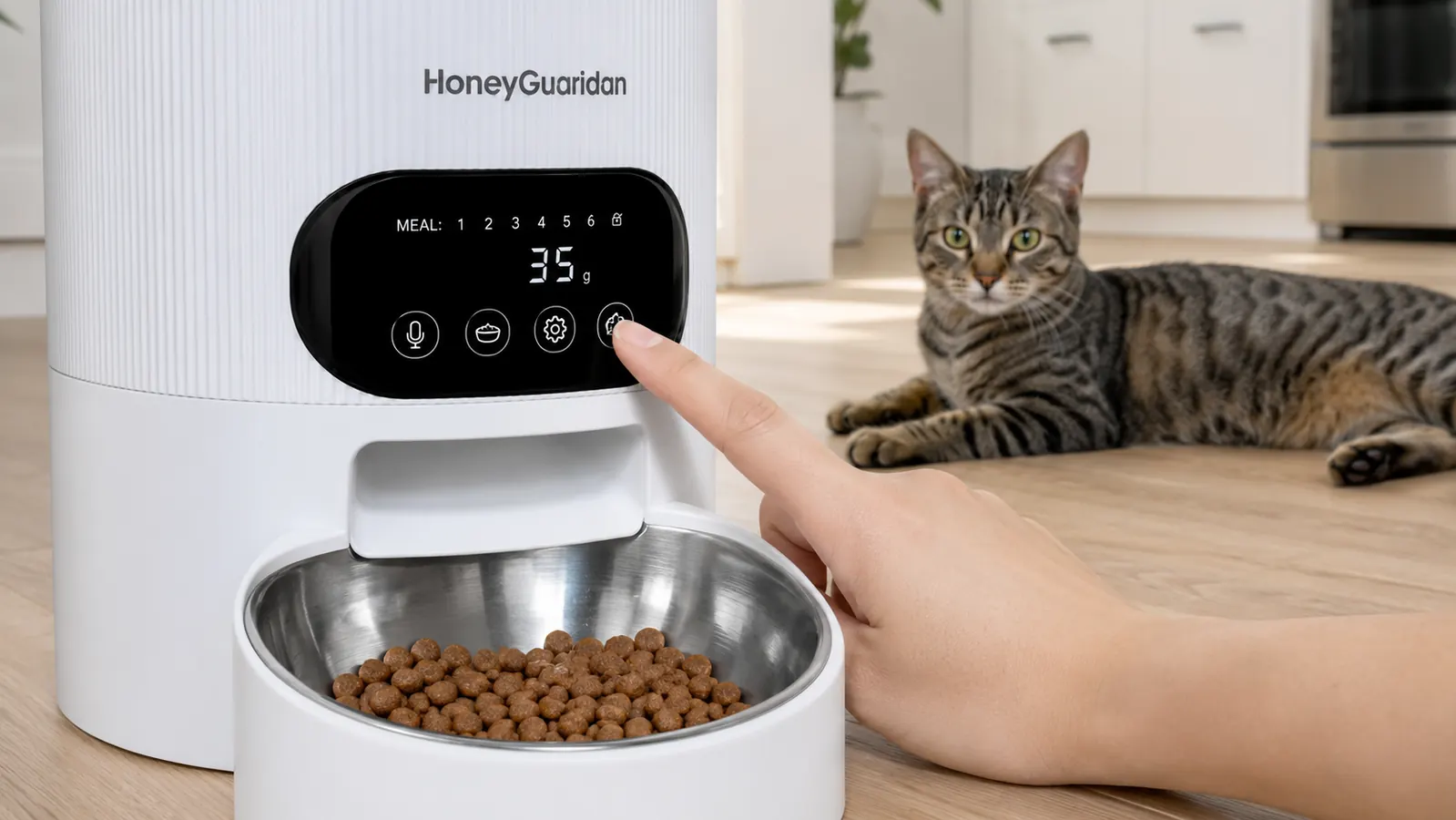
Setup takes about ten minutes. The feeder holds 3.5 liters of dry kibble, which is enough for most cats to last two to three weeks between refills. You program each meal through the control panel on the front of the unit or through the companion app if you want to manage it from your phone. We prefer the app for initial setup because it lets you see all six meal slots at once and adjust portions for each individually.
Each meal slot has a separate time setting and a portion size measured in portions, where one portion equals roughly 1/12 of a cup. For a cat eating half a cup per day across four meals, set each slot to one portion. For five meals, you will set a mix of one-portion and slightly larger slots to hit your total. The feeder has a test-dispense button so you can physically watch a portion drop into the bowl and weigh it on your kitchen scale before committing to the schedule. We strongly recommend doing this calibration step before going live. Kibble size and shape affects how freely it flows, and real-world results can vary from the listed volume by 10 to 15 percent. Weigh, adjust, and verify.
The stainless steel bowl is a genuine advantage here, not a marketing detail. Stainless does not harbor the bacterial film that builds up on plastic bowls and can cause chin acne in cats. It is also dishwasher safe. The hopper itself is BPA-free plastic with an infrared sensor that detects when it is empty and alerts the app. There is no wet food compatibility, which is a real limitation for cats on a prescription wet diet. If your cat eats wet food exclusively, this feeder is not the right tool. For cats on dry kibble or a dry-plus-wet combination where the kibble portion is the one being controlled, it fits well.
Step 5: Track, Weigh, and Adjust Every Two Weeks
Portion control is not a set-it-and-forget-it system. Cats change. Metabolism slows with age, activity levels shift with the seasons, and a cat recovering from surgery may need fewer calories than they did before. The feeder removes the daily variability, but you still need to check in regularly to make sure the target is right.
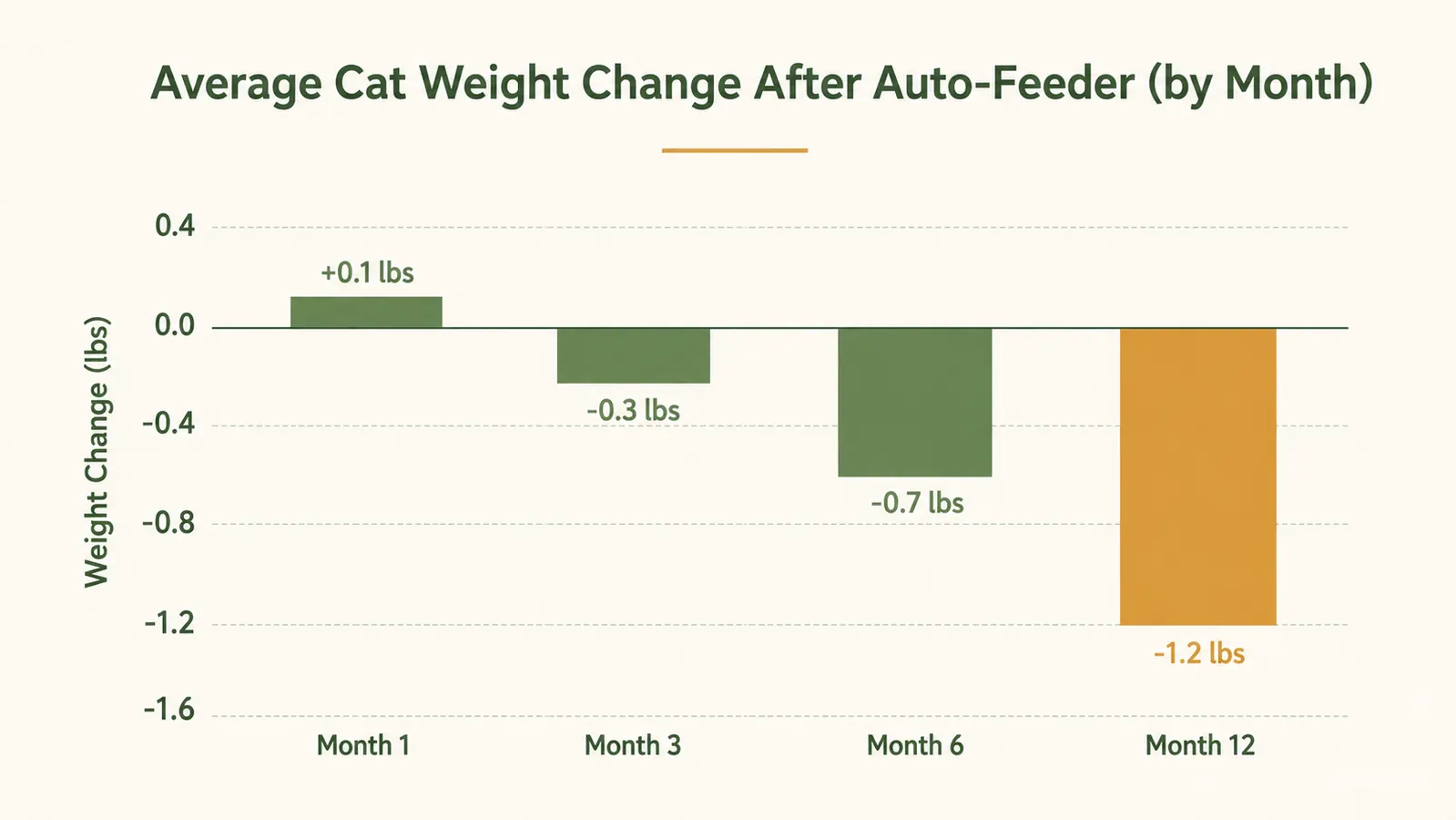
Weigh your cat every two weeks using the same method as Step 1. For a cat on a weight-loss plan, expect to see half a pound or less of loss per month. If the number is not moving after four to six weeks, reduce the daily total by 5 to 10 percent and recheck. If the number is dropping faster than expected, increase slightly. For a cat already at a healthy weight, any increase of more than a quarter pound over two weeks suggests the feeder portions need a small reduction or treats are adding up quietly in the margins.
Treats are often where the calorie math quietly falls apart. A single commercial cat treat averages 2 to 4 calories. Ten treats a day, which passes quickly when they are small, adds 20 to 40 extra calories, which is 10 to 20 percent on top of a 200-calorie daily budget. If you are going to give treats regularly, count them against the daily total and reduce the feeder portions accordingly. Alternatively, some owners use a small portion of the cat's regular kibble as the treat currency, taken from the day's total and given by hand. The cat still gets the social interaction and the reinforcement, and nothing extra enters the equation.
What Else Helps Beyond the Feeder
The feeder handles the hardest part, which is consistent dispensing at consistent times without emotional negotiation. But a few other practices reinforce the whole system and make the outcome more durable.
Feeding in a quiet, low-traffic location reduces stress eating, which is a real phenomenon in multi-cat homes where one cat rushes through a meal out of social anxiety. If you have two cats, the HoneyGuaridan has a dual-bowl configuration option, or you can run two separate feeders on synchronized schedules in different rooms. This prevents one cat from eating the other's portion, which is the most common cause of calorie miscounting in multi-cat households.
Interactive play burns real calories and enriches your cat's environment in ways that reduce food fixation. A cat that has a 15-minute active play session once or twice a day is generally calmer around mealtimes and less likely to beg between them. Exercise does not give you license to increase the daily calorie target significantly, but it does contribute to a healthier body composition over time, more lean muscle relative to fat even at the same weight.
Finally, schedule an annual weight check with your vet and bring your feeder settings with you. Showing the vet the exact daily portion in grams, the number of meals, and the current body weight trend gives them the data they need to make informed recommendations. Many vets are genuinely impressed when owners arrive with this level of detail, and the conversation becomes much more productive than a vague discussion of whether the cat seems thinner.
Your cat's waistline is only as accurate as your feeder.
The HoneyGuaridan 3.5L programs up to six meals per day, dispenses in precise increments, and sends an app alert when the hopper runs low. It is the most reliable way we have found to remove human inconsistency from the feeding equation entirely. With a 4.3-star average from more than 7,400 verified Amazon buyers, it has earned its place in the daily routine.
Amazon Check Today's Price on Amazon →